

What it is
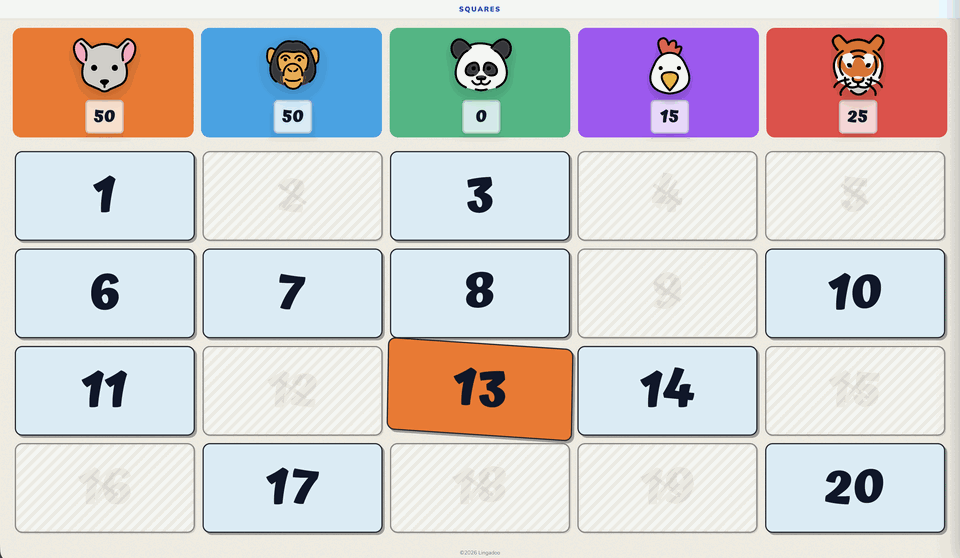
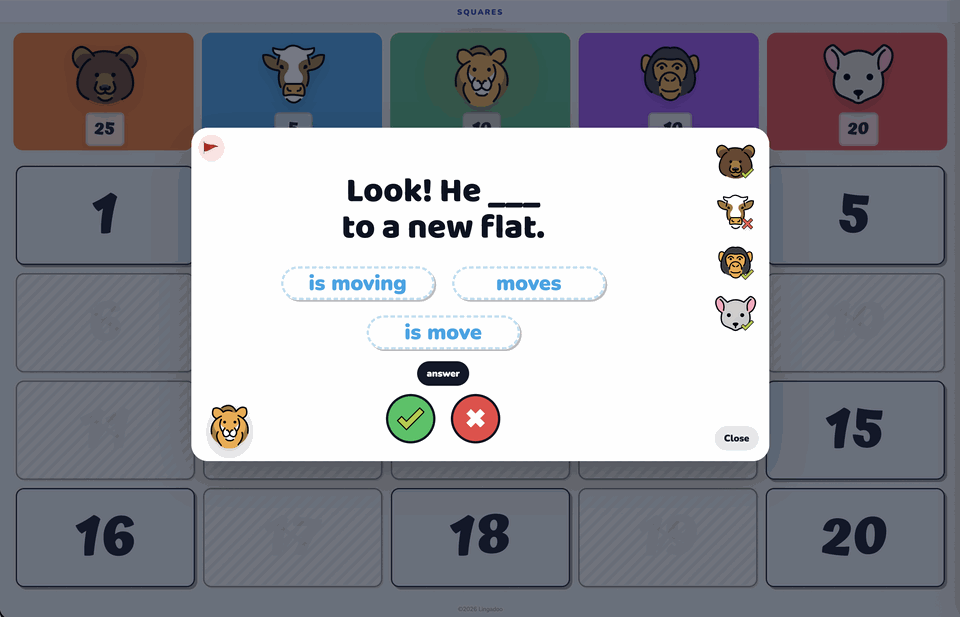
Squares is a whole-class ELT grammar game played on a shared board of tiles. Teams take turns picking a square and answering the grammar question it contains. Rivals' bets are placed once an answer is locked but before the teacher reveals the verdict, which keeps the other teams involved on every turn rather than only on their own.
Some squares are wildcards that trigger unexpected events, such as jumping a team to first place, wiping a lead, or swapping scores between two teams. These wildcards ensure the game remains unpredictable until the final square is played.
On setup, choose one to five concepts and two to eight teams. The active team selects an unused square and gives one answer. Lock it before revealing the solution, allowing rivals to bet against it. A correct answer earns 25 points; a wrong answer loses 15. A successful rival bet earns 10 points, while an unsuccessful one loses 10. Use Mixed Levels when teams have unequal English levels and the red flag to replace a faulty question. When the board is empty, the highest score wins.
Screenshots
Who it suits
Squares is a low-setup grammar game that works with most class sizes and age groups. Because every team is involved in every turn via the betting mechanic, attention stays high throughout. It covers the full CEFR range from A1 to C1 and works well as a grammar revision game at the end of class or as a warm-up for a new topic.
How classroom play works
The teacher opens Squares on a shared classroom screen (a projector, interactive whiteboard or classroom display), selects a CEFR level and grammar category, and the board is displayed. No individual student devices are needed. The teacher runs the game from a single screen projected on the classroom board.
Skill focus
Squares is primarily a grammar game. Question categories cover specific grammar targets across CEFR levels A1 to C1. The teacher selects the target before the game starts, which makes it straightforward to align with a current lesson or unit. In game, the teacher can use Mixed Levels to assign different levels to each team so, for example, one team gets A2 questions while another gets C1, and so on, to keep things competitive in mixed-level classes. Because every team is engaged on every turn, it drives more genuine grammar attention than activities where students are only active when directly questioned. See the CEFR guide for how levels are applied across Lingadoo games.